christopherhord

Archive for the ‘Uncategorized’ Category

Using AI-generated Content: beware the dangers

In Uncategorized on December 10, 2023 at 2:51 pm

It’s easy to dismiss those who worry about the dangers of AI as alarmists, although in a world where weaponized drones are piloted by AI, those concerns are closer than you might think. However, anyone who has an interest in using AI to help them generate content for blogs, articles, reports, etc., faces more conventional, but very real dangers.

Thinking of using AI to generate reports or other documents for business use? Think carefully. In June, a New York judge fined NY attorneys Steven Schwartz, Peter LoDuca and their law firm Levidow, Levidow & Oberman for “acts of conscious avoidance and false and misleading statements to the court.” Their offense? In a bid to save some time, the lawyers used ChatGPT to generate a brief in a case they were working on. ChatGPT provided them with six fictitious cases as citations.

Want to use AI-generated images or copy on your blog, your company website, or in marketing and promotional materials? Not so fast. AI has a nasty habit of occasionally belching up entire sections from works that it has scanned. Since the most popular chatbots have all been trained from sources including copyrighted material, you can end up plagiarizing copyrighted work. Microsoft, OpenAI, Google and GitHub are just a few of the prominent companies that have been sued for using copyrighted material.

Currently, several coalitions of prominent novelists, non-fiction writers, and artists have all filed lawsuits against various AI companies for unethical training models. If you use material generated through any of their AIs, you could be using copyrighted material as well, and be legally liable.

The main AI giants are working feverishly to try to create tools that will not present users with copyrighted material but other problems remain, including AIs creating objectionable material, inaccurate material, and material that uses appropriate jargon, but is ultimately meaningless.

To illustrate, I recently created a thesis statement for this article and ran it through Google Bard AI and ChatGPT to get their take on the topic. The thesis statement was as follows:

“There are many concerns when using a chatbot to create a document using large language model AI. This technology sometimes delivers vague generalities, incorrect results, inaccuracies, plagiarism, and disturbing results. Write an article about this topic, including your sources.”

Admittedly, the results were moderately impressive in a limited way, although there was a glaring, major flaw. I had tried out Bard in ChatGPT earlier in their development. I found them interesting but not terribly useful and had not been back in a while. The products have both made strides forward since then. For instance, since I asked them to write an article, both of them knew enough to create headlines and subheads that were catchy, and to divide up the content in such a way that each section fit with its appropriate subhead. This was something that they could not previously do.

But the problem came in my request that the chatbots show their sources. Each chatbot made a casual gesture at showing sources but their attempts were feeble, and possibly misleading.

For instance, here are some sources that Google Bard included at the end of its article:

  1. Bender, Emily M., and Timnit Gebru. “On the dangers of stochastic parrots: Can language models be too big?” arXiv preprint arXiv:2101.08236 (2021).
  2. Brundage, Miles, et al. “The malicious use of artificial intelligence: Forecasting, prevention, and mitigation.” arXiv preprint arXiv:1802.07228 (2018).
  3. Zhang, Xiangyang, et al. “Detecting plagiarism in large language models.” arXiv preprint arXiv:2201.01809 (2022).

On the surface, that looks pretty promising. However, looks are deceiving. The most obvious problem is that the numbers before each citation seem like they might relate to something in the article, much like footnotes. But they do not. There are no corresponding numbers in the article, relating to these cited works. And, since there are no direct quotations or specific factual statements, only generalities, it is impossible to tell what the sources relate to. And, because of the tendency of large language models to simply associate words that it sees used together in other works, there is no guarantee that the sources were ever used in the article at all. They may simply have been cited several times in other pieces the AI scanned.

The results for ChatGPT were even worse. Only two sources were cited, one of which was a paper from chat GPT’s parent company, OpenAI, and no information was provided to help us determine how these two citations were used, or even if they were used.

So beware. Even asking the AI to show its sources does not give you reliable information, or even information that is very helpful to you in double-checking the AI’s result against its sources. This is an extraordinarily dangerous situation for people who are creating text with chatbots that they plan to use In other circumstances. Until AI makers solve the problem of creating more transparency in their sources, it is probably best to avoid using AI-generated content as a quick fix, for the time being.

A great utility for Mac music makers

In Uncategorized on November 6, 2023 at 12:55 pm

I’ve been caught up working on another article, but I recently ran across an absolutely handy tool for Mac users, who create audio using powerful and sophisticated, digital audio workstations (DAWs). That’s a fairly specific group, but since Apple has always been relatively strong with media creation professionals, there are quite a few of us out there.

Logic Pro is one of a wide ranging variety of programs that increase their power and flexibility by allowing users to install plug-ins to add or enhance features. Users of programs as widely diverse as Adobe Photoshop, Google Chrome or Microsoft Office may have used plug-ins to extend any of those programs.

As many of us learned to use our DAWs, we quickly discovered that, in addition to the stock plug-ins that came with whatever program we decided to use, there was a world full of good, third-party, plug-ins that could significantly extend your DAW’s power. Some of these are highly sophisticated, professional tools, and are frequently commensurately expensive. But there are many good plug-ins that you can buy at a bargain, and many others are available for free.

The result? Well, if you can be enticed by new, shiny objects, there’s a chance you’ve ended up with way too many plug-ins on your machine. Some of them may be out of date and creating problems. Others are simply taking up space on your hard drive, and in your DAW interface, when you hardly ever use them anymore.

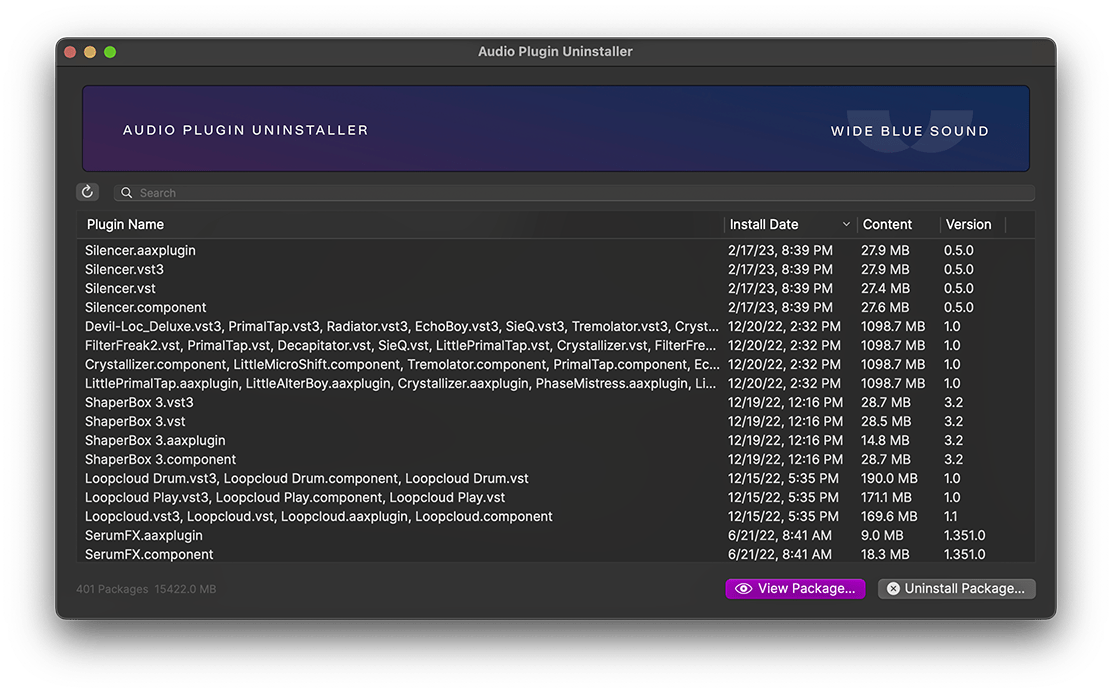
This leads us to a simple little app, called Audio Plug-in UnInstaller from software developer Wide Blue Sound (https://www.widebluesound.com/audio-plugin-uninstaller/). It does just what the name implies. Plug-ins can be removed by hand, but if it’s something you haven’t tackled before, you may need to do a little research before you learn exactly where to look for the files that you need to delete and many plug-ins install files in several different places, so removing them manually can become quite time-consuming.

The app works very simply and, it only requires a few steps. You simply enter your email on the product page (at the URL listed above) and the developer will send you an email with the download link. To install, simply drag and drop the file into your applications folder. Double-click to launch it. It will automatically check the system folders that are normally used for audio plug-ins and display a report of any plug-ins that it can uninstall.

The process is relatively noninvasive because programming best practices require developers to include data in their plug-ins that lists what files get installed and where. However, one important note. I was disappointed to see how many plug-in developers do not follow best practices. In these cases, you must still manually uninstall plug-ins, but the application can still save you some time in frustration.

A quick shout out to the music production blog Production Experts (https://www.production-expert.com/), where I first learned about this handy utility.

Tacoma joins site uniting private sector, public works

In Uncategorized on June 25, 2013 at 4:08 pm

My poor little blog has kind of been on hiatus, while I’m in development of a bigger, more sophisticated site, but I was recently reminded of an issue I want to explore, so I thought I’d share the setup with you now.

Tacoma recently became one of 20 cities, worldwide, who joined with Citymart.com to create LLGA|Cities Pilot the Future — a website seeking private enterprise to tackle public works problems. Each city identifies specific issues they’re looking to solve. The LLGA website provides an online marketplace to connect companies, entrepreneurs, organizations and interested individuals, who can propose solutions to these issues.

I became aware of the program late last year, when Tacoma announced a January 31 deadline to propose solutions to these challenges. Then, a group including the participating cities and cosponsors — Oracle, the UN Global Compact Cities Programme and The Climate Group — would invite the groups with winning proposals will be announced in San Francisco in May of this year.

“We have established high standards and expectations for sustainability, and Tacoma’s participation in this global challenge further demonstrates our commitment to protecting the environment and ensuring a sustainable future for younger generations,” said City Manager T.C. Broadnax, at the time.

However, I recently visited the LLGA site and so no indication that Tacoma found a solution for its issue. They were seeking a tool to help calculate the return on investment for sustainable infrastructure projects, to help them evaluate future projects. Visiting the City of Tacoma website only mentions that pilot solutions were scheduled to start this month. We’ll investigate further, and report whatever became of the project.

Other participating cities include Barcelona, Boston, Christchurch, Lagos, London, Mexico City, Paris, Rio de Janeiro and San Francisco.

GarageBand for iPad, and other apps

In Hardware, Music, Publishing, Technology, Uncategorized on March 30, 2012 at 12:21 pm

My newest gig is writing some beginner-level user guides for Apple’s recently updated GarageBand for iPad app. One of the nice things about this is the client wanted guides for all of Apple’s new iLife apps — GarageBand, iPhoto and iMovie — and wants one version of each for iPhone, and for iPad. Since I haven’t committed to getting an iPad yet, so they’re sending me a loaner for the project. I already have an iPod touch, so that can stand in nicely for the iPhone.

GarageBand icon

GarageBand for iPhone and iPad is quietly revolutionary

I’m already a GarageBand for iPhone user, on my touch, so I decided to start with that one. The more time I spend with that app, the more I become convinced it is truly one of the fines pieces of music software I’ve ever encountered. As both a musician and a programmer, I’m a little picky on this topic.

Don’t have time to go into a lot of detail about the app right now, but I am thinking it’s a topic some readers might enjoy. After I finish the main project, I should probably have some fresh material I can turn into a blog post. So, if you’re a current user of the app, or you’re just curious, keep an eye out for some detailed information in the near future.

Also on deck, some web development adventures with Joomla. That’s a project that has been a lot of fun, and I’m looking forward to sharing!

A new resolution for a new year

In Arts, General, Media, Music, Programming, Publishing, Technology, Uncategorized on January 22, 2012 at 8:01 pm

Made It Through Christmas Again

My Christmas song launched in december

Part of my resolution is simply to blog more, of course, and this post starts that ball rolling easily enough. But there’s more than that — I need to exploit this blog a little more to promote some of my projects. I always feel a little self-conscious about promoting my projects but I’ve got enough interesting items going on right now that I want to start getting information out there.

I am currently working a contract with a Prominent Internet Retailer but I don’t think I can say much about that. Too bad, because the project was pretty ground-breaking in nature. I think I will ask around and see what I can reasonably discuss, but that’s for a future post.

Probably the most colorful item I’ve managed to accomplish recently is my Christmas song. In November, Applce made a version of their Garage Band for iPad for the iPhone and iPod touch. I was very excited by this news, because all the reviews I read had me convinced the app would be useful to me.

I’ll write more details in a future post but, suffice it to say, I love this app. Just while I was learning how to use the app, I was easily able to create a little demo of a Christmas song I had written during the holiday season, the year before. Thus, Made It Through Christmas Again was born. I used digital distributor CD Baby and the title went on sale at Amazon, iTunes and the like just before the holiday. All my profits are going to the Make A Wish Foundation.

I’m writing a couple of e-books and editing another. Also, possibly programming a couple of iPhone apps.

These are long term projects, so this is just an overview. There’ll be updates in the near future.

Beginner programming in Python

In Uncategorized on March 30, 2011 at 5:52 pm

This is the first in a series….

Not too long ago, I went back to school to get a computer science degree. But I graduated into a tough economy and I quickly discovered that my 20+ years as a professional writer and editor was being more highly valued than entry-level programmers.

Python Powered

Recently, I began to worry about my skills atrophying so I decided to create a non-trivial application. Not only would this help maintain the language, logic and conceptual skills I learned in school, but I’d work with more real-world concerns like software design, project management and licensing. I’d gain new skills and familiarize myself with some new, useful frameworks and current best practices. When I thought of it that way, I pretty much had to do it.

The one thing I knew when I started was that I planned to develop in Python. I had been pretty well to Python in school. I liked it’s simplicity and it’s sometimes elegant use of whitespace in the code — sometimes I saw programs that almost looked like modernist poetry to me, the way they were laid out on the page. As a writer, that was hard to resist. Besides, it’s named in honor of Monty Python’s Flying Circus.

I’m developing on Mac OS X Snow Leopard (version 10.6). My current plan is to produce an app for iPad and iPhone. I’m currently just working on a couple of short modules in IDLE in a directory with some test data. While I work out some logic, I’m researching IDEs. I hope to create a decent beginning project sometime next week.

Anyway, I’ve enjoyed reading a lot of blog posts as I researched various technical issues, and I appreciate the willingness of a lot of technology experts to share their knowledge. I thought I would document some of my discoveries in the hopes that someone may stumble across an answer to a question they have….